Incident response starts to break before the first major outage. It breaks when a fast-growing company still treats every alert, customer question, and production issue as the same kind of work.
The answer is not buying more tools. PagerDuty, Jira, Grafana, and Slack can all help, but none of them creates a working operating model on its own.
Here is the model I would put in place for a GPU cloud or any customer-facing infrastructure business.
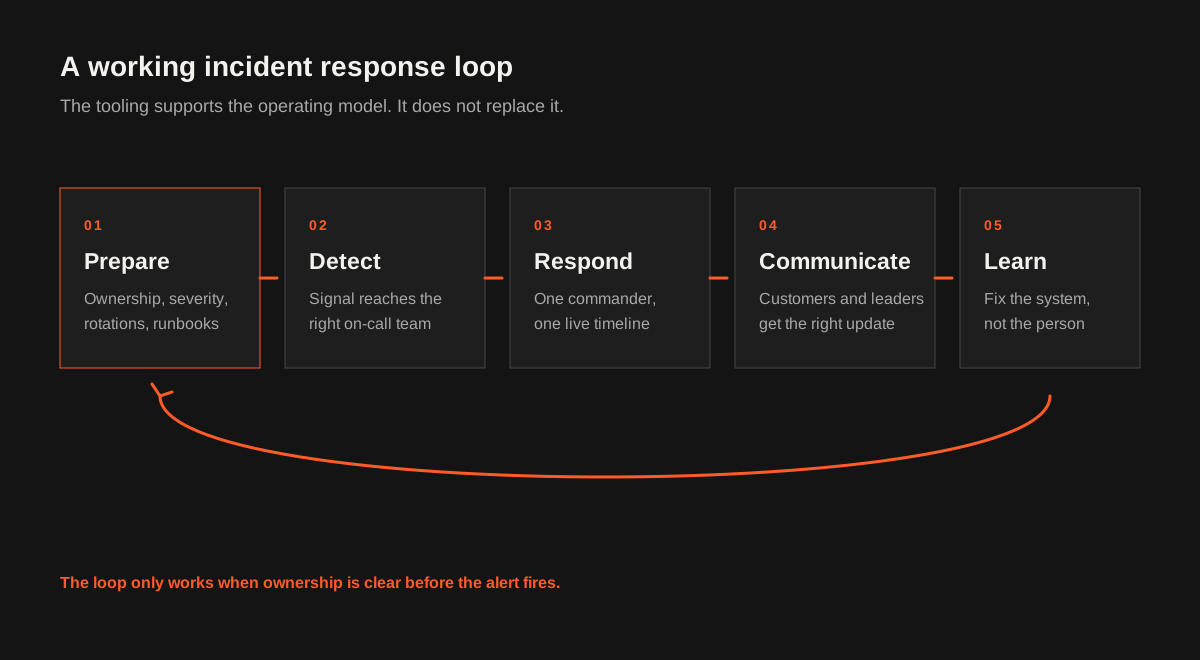
1. Prepare before the alert fires
Every service needs a named owner, an on-call rotation, a severity definition, and a basic runbook. If an alert arrives and the team needs to ask, “Who owns this?” the incident has already lost time.
This is also where you decide what deserves a page. Not every warning deserves to wake someone up. A page should mean that a customer-facing service is at risk, or that a human decision is needed now.
2. Give every signal a path
The path should be simple: monitoring detects a meaningful signal, the right on-call team is paged, and the incident is tracked somewhere durable.
For many teams that looks like Grafana to PagerDuty to Jira Service Management. The specific products are less important than the handoff. An alert cannot end in a chat channel where it disappears under the next conversation.
An alert is not an incident. It becomes an incident when someone takes ownership of the customer impact and the next decision.
3. Run one incident, with clear roles
During a major incident, one person owns the incident command. That person does not need to be the deepest technical expert. Their job is to create clarity: who is investigating, what is known, what is being tried, and when the next update goes out.
The technical team should be free to work. The incident commander keeps the timeline, holds the decision log, and stops the room from becoming ten parallel conversations.
4. Separate technical work from communication
Customers, account teams, and senior leaders need a clear update. They do not need the raw debugging thread.
The update should answer four questions: what is affected, what is the customer impact, what are we doing, and when will we update again? If there is no new technical fact, the update can still say that the team is investigating and the next update is at a specific time.
5. Learn while the details are fresh
The post-incident review is not a blame meeting. It is where the team asks which part of the system made the incident harder: a missing alert, unclear ownership, a slow escalation, a risky change, or a runbook that nobody could use.
Actions should have an owner and a due date. More importantly, they should improve the next response. The best signal that a review worked is not a beautiful document. It is a faster, calmer incident next time.
The practical test
Ask five questions during the next real incident:
- Did the right team get paged?
- Did one person own the command?
- Could someone outside the debugging room understand the customer impact?
- Was there a durable timeline and decision record?
- Did the follow-up change how the team will respond next time?
If the answer is no to any of them, the gap is not a failure of effort. It is a part of the operating model that has not been built yet.